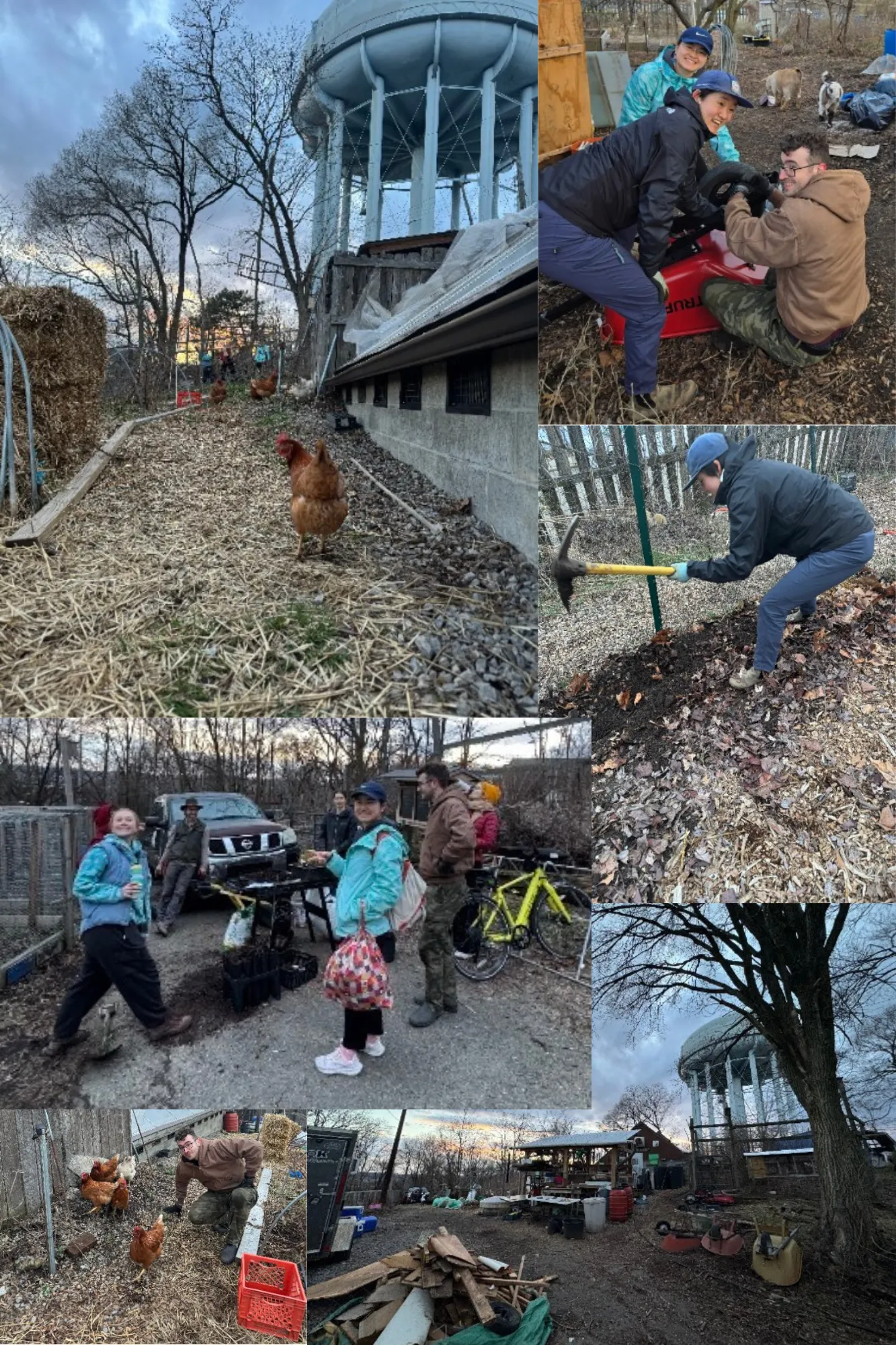
Last Thursday, the Garfield Community Farm hosted its first weekly volunteer day of the season. Over a dozen folks braved the forty-degree temperatures to pick up trash, till fields, and repair a wheelbarrow in preparation for the growing season.
I was one of them. I’ve been one of them for almost eight years, showing up to nearly every volunteer night. I even wrote an essay for Pittsburgh’s Public Source talking about why places like the Garfield Community Farm matter as much as they do. So I’m something of an enthusiast.
Later that evening, I and my close friend Lily (who also took the majority of the photos you see in the collage for this post), invited attendees to join us for dinner at the nearby restaurant, People’s Indian. Ten people showed, enough that the lovely folks at the restaurant had to move tables to sit us all together. Most of them knew me or Lily, but few of them knew each other.
By the end of dinner, that was no longer true. Introductions were made, experiences shared, and contact info exchanged. One person talked about dance classes and another — an enthusiast for Zumba — wanted to know more. Two people sitting next to each other discovered they both worked in the biomedical field. Another pair learned they both went to CMU. A group of people largely unknown to each other became more familiar.
In addition to the farm, I’ve helped another friend with gardening at their homestead, nearly every week, for about 8 years. Not much of a gardener when I started (and to be honest, still not much), I’ve nonetheless picked up a few details about how a well-tended garden works. And a well-tended community works in similar ways.
In a well-tended garden, few things serve only one purpose. One I became familiar with was the “Three Sisters” method, involving corn, beans, and squash. Corn planted in the ground provides a natural trellis for beans, which in turn fixes nitrogen to fertilize soil for corn. Squash planted around the pair provides ground cover that suppresses weeds and conserves moisture. When the growing season ends, the remnants of all three plants are broken down and given back to the soil.
The same holds true for a community. A person you meet at dinner may become a conversation partner, but they also become a source of information for what’s happening in the community, and someone who can potentially help out when you’re in need. The more people make such interlocking connections, the more you develop a resilient and organic network for mutual support.
That network keeps its participants informed on what affects the community, and makes it easier to organize collective action on behalf of that community. The Montgomery Bus Boycott, as I discussed in my Public Source essay, succeeded in large part because of the tight network of Black church groups in Montgomery. Shared purpose and shared trust made fertile soil for concentrated action, allowing each individual person to become, in a very real sense, part of something larger than themselves.
It’s no wonder, then, that active community participation is associated with better mental health. In addition to the consolation of having people who know you and understand the impact you make, a well-integrated community provides a sense of security, agency, and strength for all involved.
This is why I invest in community as much as I do. Not only because it feels good (and let me be clear — it feels great). It’s because I believe that much of what makes our lives and society better begins with strong communities as a foundation.
The pathway to strong communities is long, but it’s not necessarily difficult. It often just begins with simple things. Like showing up to a community farm on a Thursday night.
← All posts
